• Friulian is spoken in Friuli, a border region in northeastern Italy, which has long been a crossroads of cultures and conflicts, its Romance heritage disrupted in the sixth century under Germanic influence. Friulians are also an ethnically mixed people with Latin, Germanic, and Slavic heritage, owing to their position as a crossroads of cultures. Distinct from other Italo-Romance languages through features such as the loss of most final vowels, Friulian has a rich literary history dating back to the 13th century. Today, Friulian is spoken by over 700,000 people in the province of Friuli-Venezia Giulia and abroad. The language shows some geographic variation, with the central Friulian dialect forming the basis of the literary and official standard. Recognized as an official language in 1999, Friulian now holds protected status in the region, though its use is waning, especially among the urban youth.

    History

    A sense of strong local identity developed early in Friuli, especially under the Lombard Duchy (7th-9th centuries), and flourished during its “golden age” (10th-15th centuries) under the Patriarchs of Aquileia, who united religious and political power and even had a parliament. After Venice conquered the region around 1410, Friuli was allowed to keep some local institutions but lost most of its autonomy and suffered economic neglect, remaining rural and militarized as a frontier between Venice, Austria, and the Ottoman Empire. These conditions shaped Friuli’s culture and reputation, with Venetians often viewing Friulians as rough and backward. Linguistically, Friulian differs significantly from neighboring Venetian and Italian, though it was long overshadowed by Latin and Italian in writing. Some writers used Friulian for satire and folk literature, expressing local pride and their resistance to Venetian rule.

    A map of Friuli-Venezia Giulia within Italy.

    Friulian literature flourished through the sixteenth and seventeenth centuries with poets such as Girolamo Sirti, Giovan Battista Donato, and Eusebio Stella, whose works often incorporated diverse varieties of speech, reflecting the lack of a standardized variety of Friulian and the dialectal variation within the language, even in Renaissance times. Baroque writer Ermes Di Colloredo was one of the most important figures of Friulian literature, creating both poetry and prosaic works, mostly on the topic of love. In the 19th century, the movement of Romanticism also spurred a strong Friulian identity revival. Writers such as Pietro Zorutti and Pietro Bonini contributed to the push toward creating a literary standard for Friulian, with Zorutti creating a koine based on Udine’s dialect, and Bonini translating works. The Italian linguist G. I. Ascoli also played a key role, arguing that Friulian was not an Italian dialect, rather, that it was part of the Ladin—now known as the Rhaeto-Romance—language family, giving Friulian increased linguistic legitimacy.

    During the 19th century, Friuli experienced political instability and economic hardship, shifting from Venetian to French, Austrian, and finally Italian rule, with famine and overpopulation worsening poverty. With little industry and harsh land, mass emigration, naturally, occurred. By 1961, nearly 400,000 Friulians had emigrated, creating ethnic associations known as Fogolârs abroad that retained ties to and supported their homeland, especially visible after the 1976 Friuli earthquake. In the 20th century, three major historical forces shaped Friulian identity: World War I, fascist rule, and the unification with Trieste. Fought largely in and around Friuli, WWI spurred intense Italian nationalist propaganda, portraying Friulians as patriotic defenders against Austria. While suppressing local autonomy, Mussolini’s regime paradoxically promoted Friulian folklore and culture as proof of Italy’s ancient Latin heritage. Finally, after WWII, Italy merged Friuli with Trieste, a historically Austrian, cosmopolitan port city with little real connection to Friuli. Despite strong Friulian opposition, the state formed the Friuli-Venezia Giulia region in 1963, one of five regions of Italy with home rule due to their linguistic and cultural diversity. This unhappy marriage bred political tension and resentment, fueling regionalist movements such as the Movimento Friuli.

    Until about 1950, Friuli remained a largely rural and traditional peasant society, divided politically along class and geographic lines, with rural areas tending to be more left-leaning while the towns and cities supported the Christian Democrats. Post-1950 industrialization brought “suburbanization”, as people worked in new industries but kept rural homes and traditions, while economic modernization in the 1960s, driven by centralized planning, neglected mountain areas and fueled resentment toward “anti-Friulian” policies. Political and cultural conflicts emerged over military occupation, environmental degradation, and lack of a university in Friuli, leading to the birth of the aforementioned Movimento Friuli for autonomy and cultural protection, while tensions with southern Italian migrants further heightened Friulian distinctiveness. By the 1970s, these struggles turned Friuli into a center of regional consciousness and identity, with Friulian activism evolving into a multifaceted movement, despite often being dismissed as reactionary or provincial in nature. It was dominated by competing clerical, secular, and radical leftist currents, but the Movimento Friuli (MF), established in 1968, emerged as the biggest Friulian party, initially achieving notable electoral success but later declining due to internal conflicts and the co-optation of its platform by mainstream parties. The 1976 Friuli earthquake, which devastated the region, became a catalyst for cultural renewal and institutional reform, including the founding of the University of Udine. Friulian was formally recognized as a protected minority language in 1999. Since 1900, the region’s population has doubled, but is declining due to emigration and faltering birth rates.
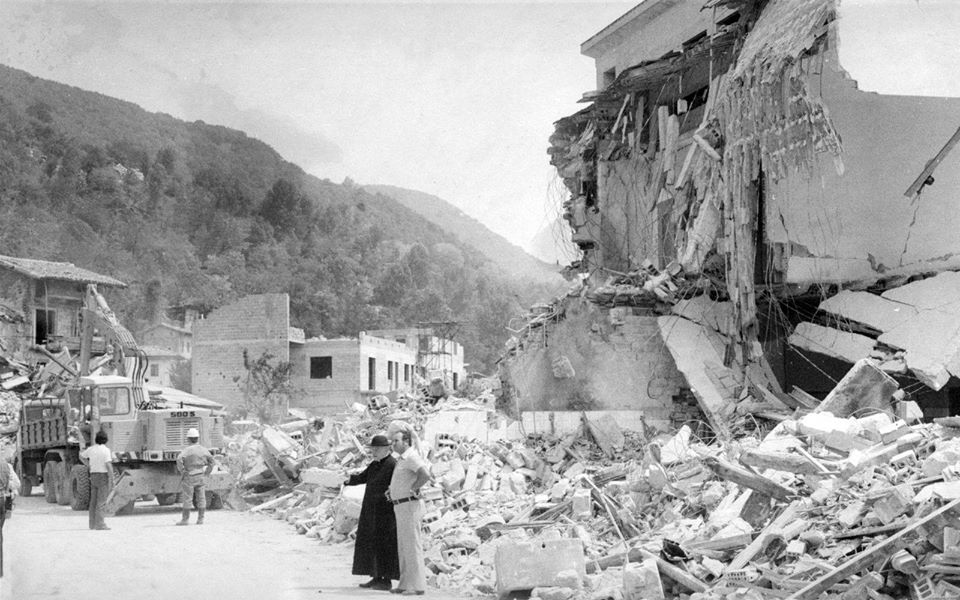
    Aftermath of the 1976 Friuli earthquake.

    Modern Day

    Roughly 650,000 people continue to speak Friulian, though the language, never taught formally in schools and long confined to familial and communal environments, is rapidly declining as Italian dominates education, media, and work. With half of parents no longer passing Friulian to their children, its survival is now in great jeopardy. While there is widespread rhetorical support for greater Friulian autonomy and cultural preservation, political and constitutional barriers complicate proposals such as separating Friuli from Trieste within the regional government. Law 482 of 1999 officially recognized historical minority languages such as Friulian, Ladin, and Sardinian, permitting their use in education, administration, and media, marking a significant step toward safeguarding Italy’s minority languages and giving some assurance of Friulian’s continued presence in national life.

    Language

    The nasals /m, n, ŋ/ can vary: /n/ often becomes [ŋ] before pauses or certain consonants, and /m/ and /n/ assimilate to the following sound’s place of articulation (e.g., [m] before /p, b/). Final /ŋ/ may surface as [iŋ] or [in], and nasals can resyllabify before vowels or /j/. The dental affricates /t͡s/ and /d͡z/ appear mainly in Italian or Latin loanwords, but [t͡s] is now rare, replaced by [s] in central Friulian under Venetian and Italian influence. /d͡z/ is also declining, with most speakers favoring [z], though conservative northern and southern varieties preserve the affricate, especially word-initially. The post-alveolar /t͡ʃ/ may shift to [t͡s] or [s] in word-final –ce endings, again reflecting Venetian and modern influence. In central Friulian, the alveolar fricatives /s/ and /z/ contrast only at the beginning of syllables. Before consonants, they may shift to post-alveolar [ʃ, ʒ] or labialized forms [sʷ, zʷ], especially in casual speech. Word-final /s/ can become voiced before voiced sounds, but /z/ never occurs finally. The post-alveolar fricatives /ʃ, ʒ/ are now mostly confined to older speakers and merge with /s, z/ in modern urban varieties, though some contrasts survive. Word-initial /j/ normally remains [j], though it can alternate with [d͡ʒ] in certain words. Unstressed [j] may also alternate with [i] after consonants. The lateral /l/ assimilates to the following consonant’s place of articulation: [ʎ] before palatals (il cjan [iʎ caan] ‘the dog’) and [l̪] before dentals (alt [aal̪t] ‘high’). Otherwise, it stays [l]. Before /j/, it may resyllabify, yielding variants like al jeve [al ˈjeːve], [aˈljeːve], or [a lʲˈjeːve] (‘he gets up’).
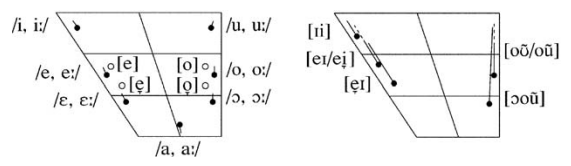
    Central Friulian has seven main vowels, /i, e, ɛ, a, ɔ, o, u/ that can be short or long, effectively doubling its vowel inventory. Long vowels are more peripheral in sound and usually occur in stressed or word-final syllables, especially before certain consonants. In many positions (like in the middle of words or before /r/), vowel length differences have mostly disappeared. Long vowels can also form diphthongs, especially in plural forms, but this distinction is weakening in modern speech. Interestingly, the northern dialects often lower high vowels (/i/, /u/) to mid vowels (/e/, /o/), a process that can spread within words. Stress in Friulian usually stays fixed, except when small words (like pronouns or articles) attach to others. Similar to English, intonation can convey meaning: statements end with a falling tone, yes/no questions have a rising-falling tone, and continuing phrases have a rise-fall-rise pattern.

    Examples

    UDHR: Ducj i oms a nassin libars e compagns come dignitât e derits. A an sintiment e cussience e bisugne che si tratin un culaltri come fradis. 

    Pier Paolo Pasolini, Ciant da li ciampanis:
    Co la sera a si pièrt ta li fontanis
    il me país al è colòur smarít.
    Jo i soj lontàn, recuardi li so ranis,
    la luna, il trist tintinulà dai gris.
    A bat Rosari, pai pras al si scunís:
    jo i soj muàrt al ciant da li ciampanis.
    Forèst, al me dols svualà par il plan,
    no ciapà pòura: jo i soj un spìrit di amòur
    che al so país al torna di lontàn.

    Sources

    Wikimedia Commons
    Civici Musei Udine
    Haller, Hermann W. The Other Italy: The Literary Canon in Dialect. University of Toronto Press, 2016.
    “Rheto-romance studies.” The Year’s Work in Modern Language Studies, vol. 73, Jan. 2013, pp. 284–291, https://doi.org/10.5699/yearworkmodlang.73.2011.0284.
    Strassoldo, Raimondo. “Regionalism and ethnicity.” International Political Science Review, vol. 6, no. 2, Apr. 1985, pp. 197–215, https://doi.org/10.1177/019251218500600205.
    Illustrations of the IPA: Friulian
  • I am aware this has been pushed out very late—It’s been a busy few couple of weeks but there’ll be more content shortly! Today we will be covering the Miskito language of coastal Nicaragua and Honduras. Miskito has an elaborate history of autonomy, linguistic contact, and suppression, surviving into the 21st century but in a tenuous position with the growing role of Spanish. The history of the Miskito people also reflects a unique microcosm of many processes in Latin American history, such as the contact between Africans, Indigenous peoples, as well as European settlers. 

    Background

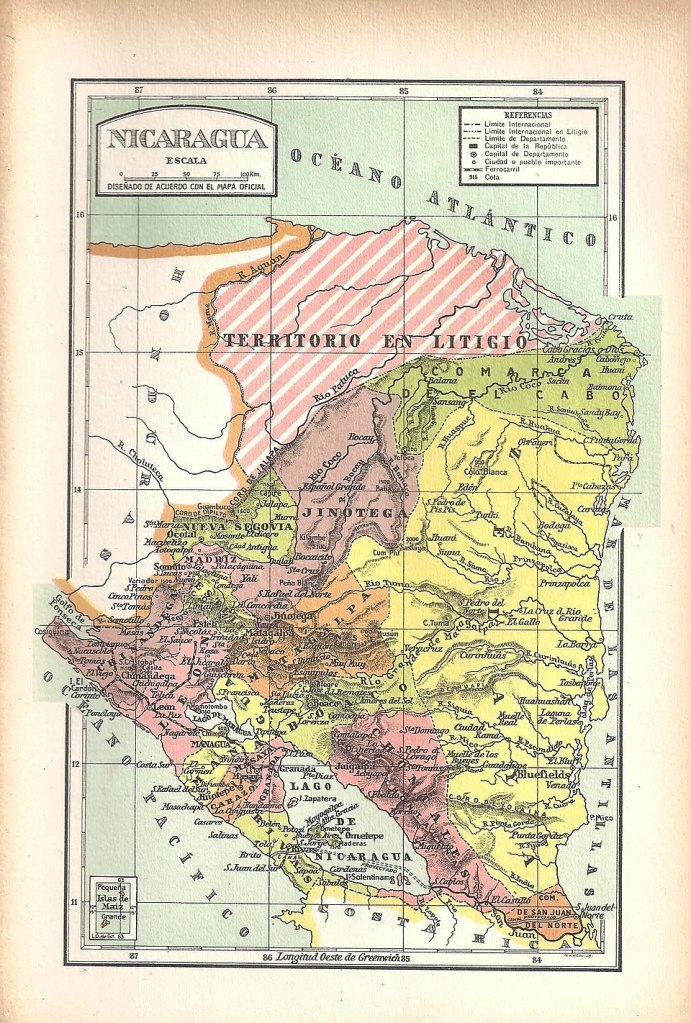
    Miskito is the most spoken language of the small Misumalpan family, located on the eponymous Mosquito Coast in Honduras and Nicaragua. The Mosquito Coast is a lush, forested, and relatively inaccessible region with a very low population density, which is partly responsible for the continued use of Miskito—only around 10% of Nicaragua’s population lives along the Atlantic Coast. Nicaragua’s Atlantic and Pacific coasts developed vastly differently, with the Atlantic coastline being dominated by the English for centuries and then economically exploited by Americans, leading to the development of Rama Cay Creole and Moskitian Creole, two English-based creole languages in the region. Furthermore, as a destination for marooned slaves, the Mosquito Coast also has a large population of African descent.

    A map depicting Nicaragua and the Mosquito Coast. The eastern shore consists of former Mosquitia.

    History

    During the seventeenth century, the English tried to block Spanish expansion by establishing colonies along the Caribbean coast of Central America, although only Belize and the Nicaraguan Coast were semi-successful ventures. While the Spanish claimed all of Central America, they had no control over the Mosquito Coast, which was instead ruled by a hereditary monarchy under the House of Miskito, propped up by and tied to British interests in the region. Throughout the late 18th to early 19th centuries, a flourishing culture of marooned and then freed slaves propped up around coastal centres such as Bluefields, creating an ‘elite’ class that had great political and economic control over the region.
    The First Treaty of Managua in 1860 turned the Mosquito Coast into a self-governing region of Nicaragua, opening the region up to exploitation by companies and increasing loss of autonomy from the Nicaraguan government. Given the critical location of Nicaragua, there were serious attempts to build a canal before the Panama Canal was built. All the proposed canal routes would have to start at either Bluefields or San Juan, both on the Mosquito Coast. Latex and logging were early lucrative ventures, but the export that outshone them all was bananas. Beginning in the 1880s, they grew to dominate the local economy, which was exploitation-oriented.
    In 1894, President Zelaya undertook the Reincorporation of the Mosquitia into Nicaragua; however, later, seeing him as a threat to American business interests, the U.S. Marines invaded the country and overthrew him. Throughout the 1920s, revolutionary Augusto Sandino’s rebellion against the American occupation targeted American businesses and caused substantial damage, leading to many American businesses leaving the country only to return under the Somoza regime, ramping up their exploitative practices and causing increasing friction between the Miskitos and Hispano-Nicaraguans. The Sandinistas who overthrew Somoza failed at least initially to empower Miskitos, but the 1987 Autonomy Statute created the South and North Caribbean Autonomous Regions—two autonomous entities to represent creoles, Miskitos, and related indigenous groups.

    Attempted canal routes across Nicaragua and the actual Panama Canal in orange. Construction of a canal across Nicaragua would have been extremely costly due to the inland mountains between Lake Nicaragua and the coast.

    Culture

    The Miskito originated as a small group around the Coco River between Nicaragua and Honduras. They engaged in small-scale agriculture supplemented by hunting and gathering. Notably, they hunted sea turtles, which also played an important role in their culture. They had a complex system of kinship where leaders or chiefs indebted people by giving them gifts, winning their loyalty. With the growth of English contact, these sparse groups began to mix with runaway slaves and marauding Europeans, obtaining technology and trade goods, growing in power, and raiding and expanding along the Atlantic coast. The ethnogenesis of the Miskito lies in their expansion and European contact, as both their acquisition of European trappings and mixture with former African slaves was what differentiated them from their Misumalpan-speaking neighbors. The Miskito had a hereditary monarchy, but it was in effect no more than a chiefdom. In the 20th century, many Chinese people settled around the coast and mixed with the Miskito population. The Moravian Church, starting in the mid-19th century, won many converts within the Miskito for their social work, but Miskito religion is still heavily influenced by their pre-Christian shamanistic and traditional practices.

    Language

    The Miskito language, though influenced by English, Spanish, and traces of African languages, has retained a strong internal structure with relatively minor dialectal variation across its 5 main dialects. Miskito word formation is largely from a small set of monosyllabic roots, and the language frequently uses reduplication to form nouns from verbs. Cultural concepts also shape expression, for example, the Miskito locate life and emotions in the heart (kupya), while the Sumu associate them with the liver. Grammar is marked by limited case inflection, with possession indicated syntactically rather than morphologically. Interestingly, similarly to colloquial English, superlatives are often formed with the word saura (“bad/awful”), comparable to “wicked” or “nasty”, both of which mean something is agreeable in the common parlance. Sentence structure typically places the verb at the end, and infinitive endings vary by dialect, with Miskito using -aya. Miskito is part of the Colombian–Central American linguistic area, along with the Chibchan languages, with which Miskito has indeed had extensive contact. Interestingly, Chibchan languages are agglutinative and have vastly different phoneme inventories.

    Modern Day

    The Miskito language remains strong in Nicaragua’s North Caribbean Coast Autonomous Region, where many communities still use it as their primary language, and it holds official recognition in local education, signage, and media. To counter the dominance of Spanish, which pressures younger generations toward bilingualism and language shift, a bilingual-bicultural education program was launched in 1984, offering Miskito-language instruction alongside Spanish in communities representing multiple dialects. While Miskito continues to fare better than related indigenous languages like Sumu and Rama, which are more endangered, its long-term survival depends on ongoing support from governmental institutions as well as the community itself.

    Schoolchildren in Bluefields in the 80s.

    Examples

    Universal Declaration of Human Rights in Miskito (Article 1):

    Upla sut ba kulkanka lakara, airaitka nanira bara pri, sin, aikuki, baku takisa. Bamna sins laka bri baku, lukanka bain pri baku aimuihni lakara, pana pana tabaikan kaiasa.

    All human beings are born free and equal in dignity and rights. They are endowed with reason and conscience and should act towards one another in a spirit of brotherhood.

    Sources

    Conzemius, Eduard. “Notes on the Miskito and sumu languages of eastern Nicaragua and Honduras.” International Journal of American Linguistics, vol. 5, no. 1, Mar. 1929, pp. 57–115, https://doi.org/10.1086/463773. 

    Noveck, Daniel. “Class, culture, and the miskito indians: A historical perspective.” Dialectical Anthropology, vol. 13, no. 1, 1988, https://doi.org/10.1007/bf00244348. 

    Olien, Michael D. “The Miskito Kings and the line of Succession.” Journal of Anthropological Research, vol. 39, no. 2, July 1983, pp. 198–241, https://doi.org/10.1086/jar.39.2.3629967. 

    Sollis, Peter. “The Atlantic coast of Nicaragua: Development and autonomy.” Journal of Latin American Studies, vol. 21, no. 3, Oct. 1989, pp. 481–520, https://doi.org/10.1017/s0022216x00018526.

    Attributions (in order):
    Public domain
    Kaidor, CC BY-SA 4.0 https://creativecommons.org/licenses/by-sa/4.0, via Wikimedia Commons
    Susan Ruggles, CC BY 2.0 https://creativecommons.org/licenses/by/2.0, via Wikimedia Commons

  • Today, we will be looking at a stamp I picked up a while ago with a turbulent history of post-Soviet conflicts, spheres of influence, forgeries, and international recognition. Despite looking nondescript, this stamp is a great insight into one of the world’s most contested regions. 

    Quick Facts

    Issuing Country: Abkhazia (Аԥсны)
    Catalogue: Michel AB 402
    Issued: April 2000
    Perforation: 11½
    Face value: 0.90 Russian ruble

    The Stamp

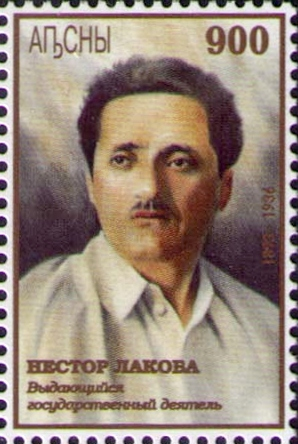
    For this stamp, it would be easier to introduce it first, then explain its significance. This is a commemorative issue from Abkhazia, a place you won’t find on a list of countries. This is because Abkhazia is a region of northwestern Georgia recognized only by 5 other countries, which might become 4 in the future with the new regime change in Syria. Along with its status as a non-country, Abkhazian stamps are not recognized by the Universal Postal Union, and are practically only valid for post within the small area itself. The design consists of the flag of the Socialist Soviet Republic of Abkhazia (Социалистическая Советская Республика Абхазия, CCPA) with Abkhazia’s name in Abkhaz, Аԥсны (Aṕsny), to the side. Despite being relatively basic, this stamp is loaded with information about the region’s past and current status, which will be discussed further in the next section.

    History

    The Abkhaz are a people native to the Caucasus region but of unclear origins. They are likely descended from the ancient Abasgoi tribe, who inhabited and gave their name to modern-day Abkhazia. Throughout most of Abkhaz history, Georgian polities ruled over the region, most famously including the Kingdom of Abkhazia, which at one point controlled almost all of modern-day Georgia, and its successor, the Kingdom of Georgia, under which Georgia entered a “golden age”. In the 16th century, the Ottoman Empire turned the Principality of Abkhazia into its sphere of influence, gradually converting many Abkhazians to Islam. The famous Turkish traveller (of Abkhaz descent himself) Evliya Çelebi was the first one to document the Abkhaz as speaking a language different from Georgian, in the 17th century.

    In 1864, Abkhazia was formally annexed by the Russian Empire, beginning centuries of Russian hegemony. Many Abkhazians were deported, leading to the repopulation of the region with mostly Georgians, Russians, and Armenians. The Socialist Soviet Republic of Abkhazia was established after the Red Army overran Georgia in 1921 during the Russian Civil War, led by Nestor Lakoba. Lakoba, popular with both the Abkhaz and Stalin, managed to dodge the worst of Soviet collectivization in the 1930s, preventing an atrocity such as the Holodomor from occurring in his homeland. Lakoba was poisoned in 1936 by an ambitious confidante of Stalin named Lavrentiy Beria, who was an ethnic Georgian from Abkhazia, and thereafter condemned as an enemy of the people and had most of his family killed as well. Beria then consolidated his control over all of Abkhazia, suppressing Abkhaz culture, purging his opponents, and resettling the region with Georgians and Russians.

    Nestor Lakoba on an Abkhaz stamp.

    In the buildup to the dissolution of the Soviet Union, ethnic conflicts intensified in Abkhazia, with Georgians and Abkhaz frequently clashing, such as in the Sukhumi riot that left 18 dead and hundreds wounded. Georgia declared independence on the 9th of April 1991 under Zviad Gamsakhurdia, who was replaced in 1992 by Eduard Shevardnadze. After a perceived move to undermine Abkhaz autonomy, fighting broke out between Abkhaz and Russian militias and Georgian forces. In late 1993, Sukhumi fell, followed by a massacre against the Georgian residents of the city, leading thousands to leave Abkhazia, fearing for their lives. To complicate matters further, supporters of the deposed Gamsakhurdia rose up in his native Mingrelia, further turning Georgian attention away from Abkhazia and leading to Abkhaz militias overrunning almost all of Abkhazia. A widespread ethnic cleansing of Georgians occurred throughout the 90s, with most of the Georgian population being killed or forcibly displaced. In 1999, Abkhazia formally declared independence and has been practically entirely dependent on Russia ever since. The conflict is still in a deadlock, although tensions have simmered down, and there is cross-border travel and commerce.

    A map of Georgia and Abkhazia.

    Abkhazian Philately

    Since Abkhazia is not recognized by most countries, it is also not part of the Universal Postal Union (UPU), which means that stamps from Abkhazia are not valid for international mail. Abkhazia has had a prolific output of stamps since its declaration of independence and there is even a catalogue of Abkhazian stamps, as well as some collectors in Sukhumi who have kept painstaking track of every emission. However, to Western philatelists, Abkhazia is probably more famous as being the purported origin of many goofy or strange stamps, which were in reality forgeries. The most famous example is the infamous “Abkhazian” Bill Clinton issues, which made fun of the Clinton-Lewinsky affair through tongue-in-cheek references. Abkhazia in general was a prime target for stamp counterfeiters due to its relative obscurity, leading to more illegal stamps under the name of Abkhazia than legitimate stamps issued by the country.

    An example of a fake souvenir sheet from Abkhazia. Notice how the country’s name is spelled wrong – it should say Аԥсны.

    Conclusion

    In the end, this small stamp tells a story far larger than its size suggests, reflecting the fraught history of Abkhazia—a land caught between empires, scarred by ethnic conflict, and suspended in a limbo of partial recognition—and a stark reminder that even the most modest artifacts can carry the weight of history, politics, and the struggles of a people seeking their place in the world.

  • Today, we will go to the arid deserts of the southern tip of Africa to discuss the Khoekhoe language, straddling the Kalahari Desert through South Africa, Namibia, and Botswana. Long grouped together with the San, a people almost as old as time itself, only recently has Khoekhoe been recognized in its own regard, although both share features that are seldom found outside of this sparsely populated region, famously, a heavy use of complex click consonants. Join us as we explore a language with a rich history and many unique linguistic features.

    Background

    Khoekhoe (Khoekhoegowab), also known as Nama or Damara, is a Khoe language spoken throughout southwestern Africa. Khoe is a small language family that is thought to have originated from central Africa before migrating south to what is now the Kalahari and South African coast, differentiating from the nearby San due to their adoption of nomadic pastoralism compared to the San’s hunter-gatherer lifestyle. Until the late 20th century, the languages of the Khoe and San were grouped under Khoisan, but later research has proven the two are unrelated, therefore making the grouping outdated. Khoe languages used to be spoken throughout modern-day South Africa before being displaced by Dutch and British settlers or adopting their languages.

    Grazing land in the Kalahari

    History

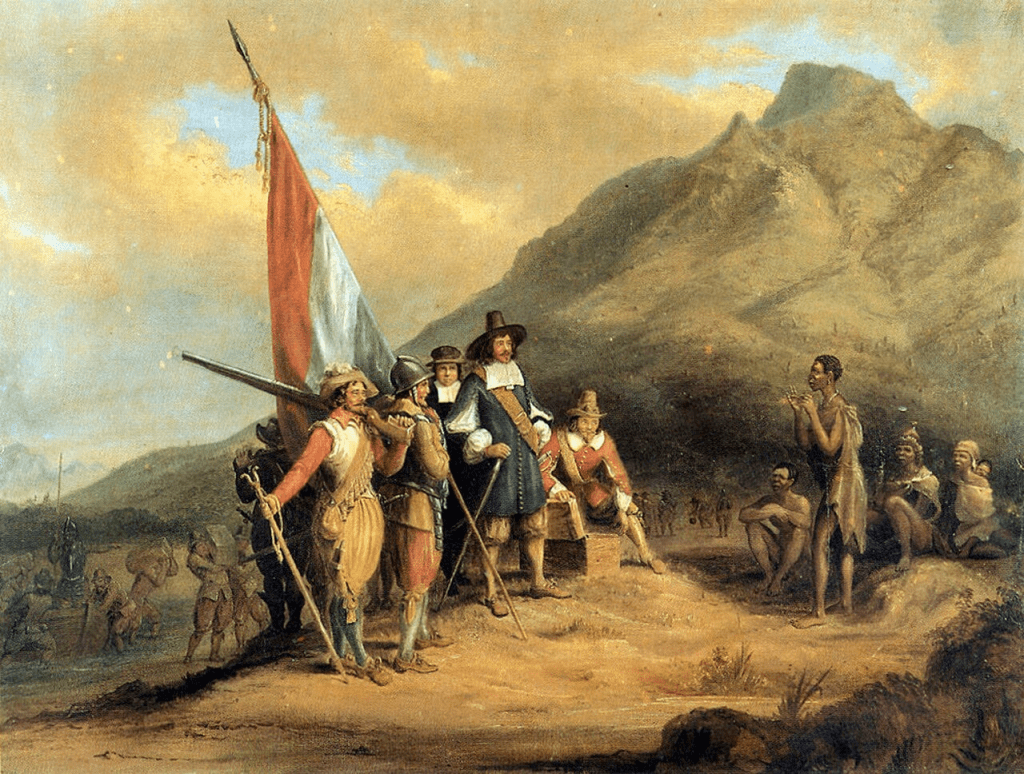
    The Khoekhoe are thought to have migrated to South Africa and Namibia from the north thousands of years ago, in contrast to the even more ancient San people. The Khoekhoe were traditionally a nomadic people who herded sheep, goats, and cattle. Bantu groups such as the Nguni (including the Zulu and Xhosa) and Sotho had arrived by 1000 AD, adopting click consonants from extensive contact with Khoe and San peoples. Many place names in South Africa originate from Khoekhoe, even as far as territory inhabited by Bantu peoples, which is recognizable due to the usage of clicks. There also was extensive bilingualism, particularly between the Khoekhoe and Xhosa. In 1652, a supply post was founded by Jan van Riebeeck for the Dutch East India Company near modern-day Cape Town, beginning the process of European settlement in southern Africa. Early contact between the Dutch and Khoekhoe was facilitated through the use of Cape Dutch Pidgin, a sort of simplified form of Dutch that utilized some elements of Khoekhoe grammar. The Khoekhoe resisted Dutch control and enslavement through the Khoekhoe-Dutch Wars but were largely subjugated and assimilated, leading to rapid language loss and the creation of new communities such as the Griqua and Basters. Similar to the Mestizos of Latin America, the Griqua and Basters were the result of relations between mostly Dutch men and Khoekhoe women; they primarily spoke Afrikaans instead of Khoe languages. The Xiri (also known as Khoemana or Korana) language is still spoken by very few Griqua, and is almost extinct. Khoekhoe is still spoken in the Richtersveld area in South Africa, while it has been replaced by Afrikaans almost everywhere else in the former range of the Khoe peoples. The Cape Coloured community which makes up most of the interior Cape is a mixed community of mostly Khoe, European, and Asian descent.

    Jan van Riebeeck negotiating with Khoekhoe

    From 1904 to 1908 the Herero and Nama genocide systematically eradicated thousands of Namas under the colonial German regime through intentional starvation and dehydration as well as the use of concentration camps. In 1980, the Nama (the predominant group of Khoekhoe speaking peoples) received nominal independence as the Bantustan of Namaland. The Bantustans were self-governing entities set aside for specific African communities, where it was planned to eventually deport all Africans. Namaland dissolved after South Africa agreed to grant Namibia independence in 1989, with the former territory being part of the new nation.

    Culture

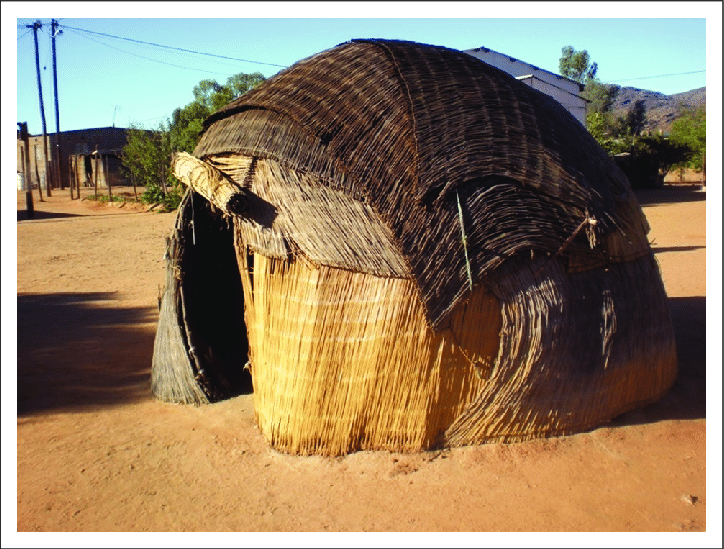
    As mentioned before, the Khoekhoe are traditionally nomads who practiced pastoralism, particularly raising sheep and goats. The Khoekhoe traditionally lived in huts, known as matjieshuise, which were portable and well-suited to their nomadic lifestyle. Women traditionally played an important role in building these huts, while men were primarily responsible for herding livestock. The Richtersveld on the border between Namibia and South Africa is recognized as a UNESCO World Heritage Site for the transhumance traditions of the Nama people who live there. Khoekhoe culture was also rich in oral traditions, with stories, songs, and rituals passed down through generations.

    Language

    The Khoekhoe language is most notable for its extensive use of click consonants, which are seldom found outside of southern Africa. The 5 types of clicks in Khoekhoe are the bilabial, dental, alveolar, palatal, and lateral clicks, which can further be combined with other consonant sounds and released in various ways, creating a highly complex system of sounds unique to these languages. Khoekhoe in fact has 20 clicks and only 11 non-click sounds. Khoekhoe is also a tonal language and, like most languages, uses SOV word order.

    Modern Day

    Despite being the largest of its language family, Khoekhoe is becoming a vulnerable language. Khoekhoe is a recognized language in Namibia and South Africa, where most of its speakers live. In Botswana, many Khoekhoe speakers, especially among the youth, are shifting to Setswana, due to traditional stigma against Khoekhoe and extensive code-switching between Setswana and Khoekhoe. Compared to other African language families, research in Khoekhoe has only recently made significant breakthroughs and still remains to be studied further.

    Examples

    There are not many written materials in Khoekhoe; not even the Universal Declaration of Human Rights has been translated into the language. Here are some spoken examples on the internet that particularly demonstrate the unique click consonants:

    Beautiful click consonants in Namibia’s Khoekhoe language | Emeloelaj speaking Nama | Wikitongues
    https://www.britannica.com/topic/Khoekhoe-languages#/media/1/316784/68882

    Conclusion

    Khoekhoe represents a fascinating example of cross-linguistic contact and linguistic areas with its transmission of click consonants to other southern Bantu languages, for which they are famous, but one of the progenitors of the expansion of click consonants across this region is at risk. With parents not wanting their children enrolled in Khoekhoe schools, weakening an already small community, the Khoekhoe need further support and resources for the chain of language transmission to remain intact. Furthermore, the increase of globalization favouring English and Afrikaans also set Khoekhoe on unstable foundations, and there needs to be more research on the language. Despite all of these factors, there are already Khoekhoe schools, radio stations, and videos online teaching people how to speak it. There is hope that this rich tradition and language will continue to thrive in one of Earth’s most barren corridors.

    An example of a traditional Khoekhoe hut structure

    Sources

    “Language vitality among the Nama of Tshabong” (47-56). Batibo, Herman M. and Tsonope, Joseph (2000)
    Barnard, A 2008, ‘‘Ethnographic analogy and the reconstruction of early Khoekhoe society’: Southern
    African Humanities: A Journal of Cultural Studies’, Southern African Humanities, vol. 20, pp. 61-75.
    Barnard, Alan. Hunters and Herders of Southern Africa: A Comparative Ethnography of the Khoisan Peoples. Cambridge University Press, 2004.

  • This week, we will examine the Jeju language of South Korea. Home to the now ubiquitous K-pop and many cultural exports, as well as one of the most ethnically homogenous societies on Earth, Korea has a little-discussed language spoken on one of its most popular tourist destinations: Jeju Island. Despite its unique geographical position and culture, the language is almost on the verge of death. Join us as we take a look at Korean’s distant islander cousin.

    Background

    Jeju (제줏말/Jejunmal) is a critically endangered language spoken on the island of Jeju, located around 50 miles off the coast of the Korean peninsula. Although there is some debate, Jeju and Korean are generally regarded as the only extant members of the Koreanic language family. Due to its close relation to Korean, Jeju was often regarded as a dialect of Korean; however, the two languages are not mutually intelligible. Jeju is also one of only 3 languages in the world that use the Hangul writing system. Due to rapid language shift, only an estimated 5,000 speakers of Jeju are left.

    History

    The first signs of human settlement on Jeju date to around ten thousand years ago, with the first evidence of an organized polity being the Tamna kingdom. According to Vovin, the original inhabitants of Tamna were Japonic, but it was later conquered by proto-Korean invaders. However, we do know for sure that in 476 Tamna became a tributary of the Baekje kingdom on the mainland, later switching allegiance to the Silla kingdom. The island was annexed by the Goryeo in 1105 and later invaded by the Mongols, who held it for around one hundred years. In 1404, the island switched hands yet again to the Joseon, who prohibited its residents from leaving the island and brutally crushed uprisings throughout the 19th century. In 1520, Kim Jeong, author of the Topography of Jeju Island, visited the island and reported having difficulty understanding the island’s local speech – the first documented report we have of a difference between mainland Korean and Jeju. From 1910 to 1945, the island was occupied by the Japanese, but the worst event in the island’s history came during the Korean War. An event invariably tied to the history of Jeju that comes up with any discussion of it, the 4·3 incident or Jeju uprising was the worst atrocity in the island’s long history of repression. In response to an insurgency by communist rebels around Hallasan Mountain, for months, Korean soldiers and right-wing irregulars killed around 30,000 people – 10% of the island’s population. Entire villages were systematically eradicated as anyone in the island’s interior was considered a rebel, and most members of the local elite were wiped out. The events were persistently denied and covered up throughout the many decades of military rule in Korea, but a truth commission created in 2000 sought to bring reconciliation. Still, it remains a controversial matter, with many right-wing Koreans denying it or claiming it was deserved, while history textbooks have only recently included it in response to public pressure. While there is not much documentation of the language’s history in particular, all of these events let us glean how the island’s turbulent history led to the language’s almost moribund status today. Centuries of oppression and discrimination fostered linguistic diversity early on, but later discouraged people from speaking it and eventually contributed to its decline in usage.

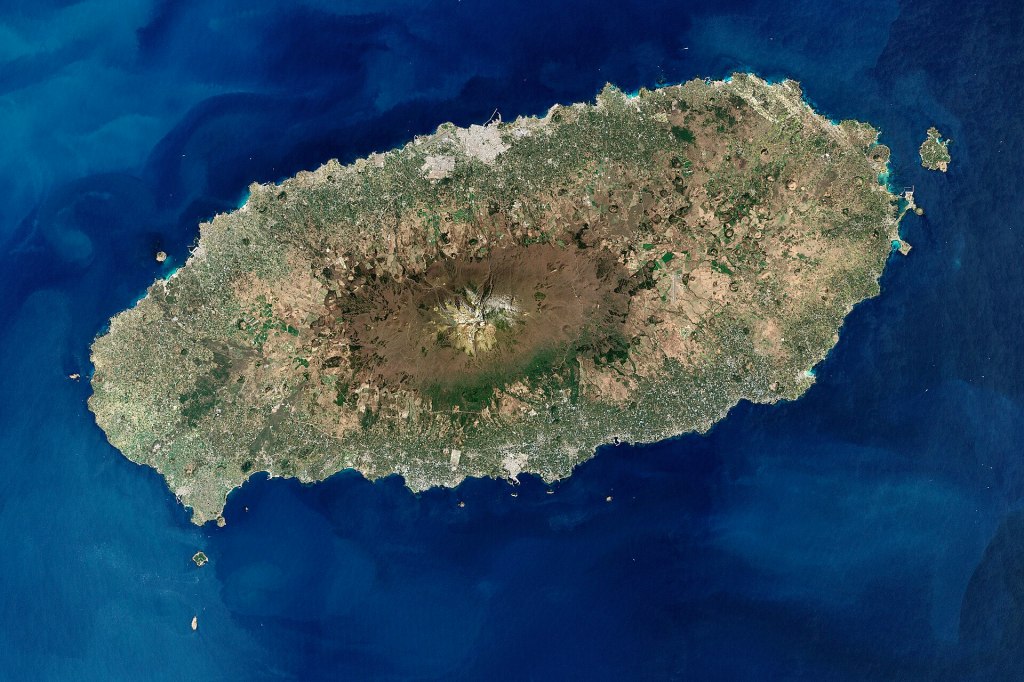
    A satellite image of Jeju.

    Culture

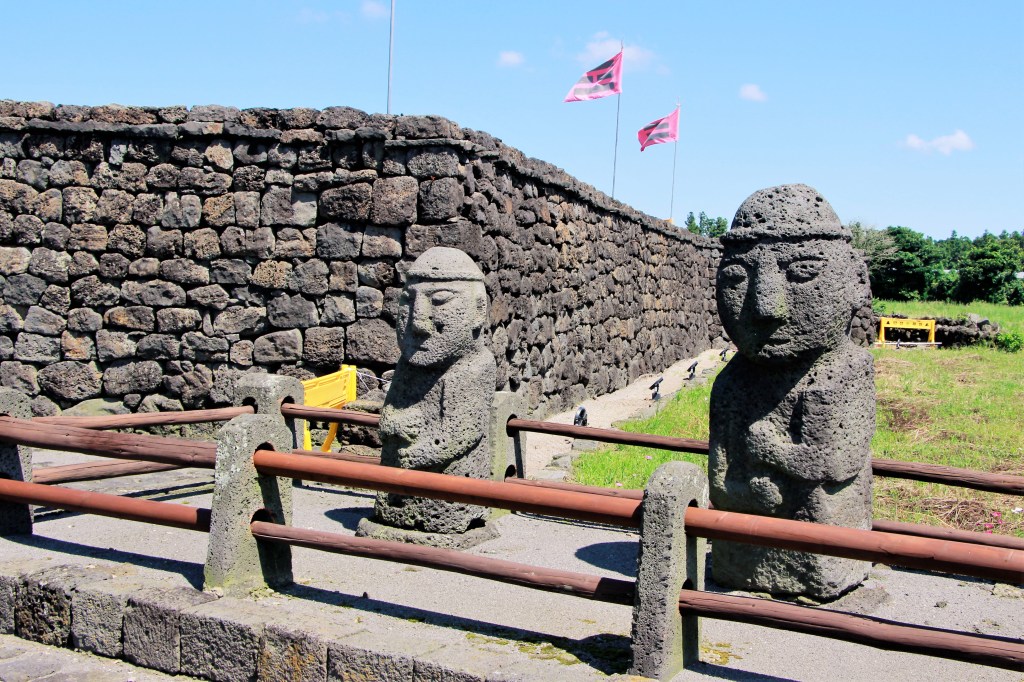
    Jeju is well known for its unique culture, with many customs and traditions that are not found on the mainland. Perhaps the most well-known of these are the dolhaleubang or ‘stone grandfathers’, large stone statues that represent good luck. The haenyeo or ‘sea women’ are also part of the island’s unique cultural heritage, diving into the ocean without any gear for chiefly abalone, a type of sea snail enjoyed as a delicacy on the island and in other cultures as well. Jeonbok-juk, or abalone rice porridge, is a local specialty of the island and one of its chief dishes. Jeju’s creation myth involves three demigods, Go, Yang, and Bu, who came out of the earth at a place called Samseonghyeol in Jeju City, marrying three princesses and beginning to cultivate the land, thus beginning the island’s history. Other pieces of recognized cultural heritage include chilmeolidanggus, a ritual of traditional Jeju shamanism, Mangeon headbands, Tangeon hats, and folk songs known as Jeju minyo. Traditions such as the island’s traditionally matriarchal family structure and the creation of stone structures such as jeongnang, bangsatap, and doldam also define the unique culture of Jeju Island.

    Dol hareubang on Jeju.

    Language

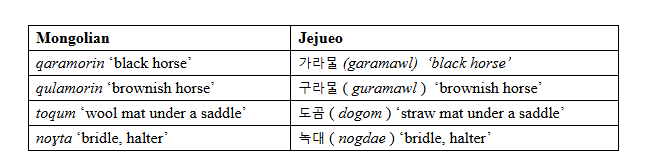
    Jeju has no standard variety but can roughly be split into 2 dialects, one spoken in the north and one in the south of the island; a slight east-west divide also exists. The language has significant overlap with Korean in terms of phonology but uses a vastly different vocabulary, making it mutually unintelligible with standard Korean. In a 2014 study, speakers of Jeju and Korean were found to view both languages as similarly or even less intelligible than speakers of Dutch and Norwegian when exposed to a narrative in the language. Jeju has 9 vowels compared to Korean’s 8, as it preserves the vowel /ɒ/, found in Middle Korean but lost in modern Korean; it also preserves some elements of vowel harmony found in Middle Korean, containing 2 classes of vowels and a neutral /i/. Unlike Korean, however, Jeju has fewer levels of formality, around 4 compared to Korean’s 7. This has also contributed to traditional negative stereotypes of the language as being informal and impolite. Interestingly, Jeju has many Mongolian loanwords stemming from a century of Mongol rule over the island, primarily related to animal husbandry.

    Loanwords from Mongolian in Jeju.

    Modern Day

    A popular notion in Korea, also espoused by the government, is that Koreans’ national identity is bound to a single shared language. This has undoubtedly had great consequences for Jeju, as it had been classified as a dialect of Korean until recently – even now, its status as a language is controversial to some. However, on a positive note, under its classification as a dialect, much research was still conducted on it by Korean experts. According to UNESCO estimates, around five to ten thousand islanders can speak the language, or around one to two percent of the population. Even this estimate is probably highly optimistic, as many of the few that can speak it only have limited fluency or spoke it in their youth but have lost most of their abilities. In general, the speaker base has been confined to the elderly.

    Examples

    In isolation, Jeju seems very similar to Korean, but I found it very productive to look at comparative studies of phrases in Korean and Jeju and see the differences between them. Some examples include:

    Comparing a basic Jeju sentence with Korean:
    ‘A farmer was planting a tree.’
    Korean: Nongbu namu sim-go iss-eoss-eo. (농부 나무 심고 있었어)
    Jeju: Nongbani nang singg-eoms-eon. (농바니 낭 싱ᅥ언)

    Part of a Jejuan creation myth:
    Korean: Neo Song Saman-ineun gyeou seoleun-i sumyeong-ui kkeut-ini, seoleun doeneun haeeneun amu dal amu nal-e myeong-i kkeutnal teimeulo neoga bal-i sal-aseo umjig-il su iss-eul ttae naleul namusup-eulo delyeoda dalla (너 송사만이는 겨우 서른이 수명의 끝이니, 서른 되는 해에는 아무 달 아무 날에 명이 끝날 테이므로 너가 발이 살아서 움직일 수 있을 때 나를 나무숲으로 데려다 달라)

    Jeju: Neu Song Sawman-i jeonmaeng-i gawt seoreun-i maeg-inan, seoreun naneun hae-e amu dawl amu nar-eun maeng-i maeg-ini neu-ga bal sarang omong-hawyeo-jil ttae, na-reul nang-gos-euro gawjyeoda dora (느 송ᄉᆞ만이 전맹이 ᄀᆞᆺ 서른이 매기난, 서른 나는 해에 아무ᄃᆞᆯ 아무날은 맹이 매기니 느가 발 살앙 오몽ᄒᆞ여질 때, 나를 낭곳으로 ᄀᆞ져다 도라)

    Basic phrases:

    밥 묵었수과? (bap mugeossukwa?): Have you eaten? (Fig: how are you?)
    고맙수다 (gomapsuda): Thank you
    반갑수다 (bangapsuda): Nice to meet you
    멧 시우꽈? (met si-ukkwa?): What time is it?
    미안ᄒᆞ다 (mianhawda): I’m sorry
    일흠이 무신거우꽈? (ilheum-i musin’geo-ukkwa?): What is your name?
    펜안ᄒᆞ우꽈 (pen-anhawukkwa): How are you/Hello
    ᄒᆞᆫ저옵서예 (hawnjeo-op-seo-ye)/ᄒᆞᆫ저옵서양 (hawnjeo-op-seo-yang): Welcome
    봅서 (bopseo): Hello
    기여 (giyeo)/예 (ye): Yes
    아니다 (amida)/말다 (malda): No

    This website has many spoken conversations in Jeju: jeju-kim-0351 | Endangered Languages Archive

    Conclusion

    Despite the almost moribund status of Jeju, there are many efforts to preserve it that may bear fruit in the future. The Jeju Language Preservation Society was founded in 2008; in 2011 the government of Jeju approved the Language Act for the Preservation and Promotion of Jejueo, while the Jeju Office of Education also created a General Plan for Jejueo Conservation and Education in the same year. According to the authors of Jejueo, the conditions are ideal for a language revival, with there being strong support, documentation, and infrastructure in place that could spark a possible revival of the language. Only time can tell what the future may bring, but we can hope that, perhaps in the future, Jeju and Korean can coexist on the island.

    Hallasan Mountain.

    Sources and Attributions:

    Sources:
    Yang, Changyong, et al. Jejueo: The Language of Korea’s Jeju Island. University of Hawai’i Press, 2020. JSTOR, https://doi.org/10.2307/j.ctvwvr2qt. Accessed 20 Aug. 2025.
    Kim, Hun Joon. The Massacres at Mt. Halla: Sixty Years of Truth Seeking in South Korea. Cornell University Press, 2014. JSTOR, http://www.jstor.org/stable/10.7591/j.ctt5hh0hs. Accessed 20 Aug. 2025.
    Vovin, Alexander. From Koguryo to T’Amna.

    Attributions (in order):
    Public domain via NASA
    Trainholic, CC BY-SA 4.0 https://creativecommons.org/licenses/by-sa/4.0, via Wikimedia Commons
    Screenshotted from Jejueo – Jejueo-English Basic Dictionary 제주어-영어 기초 사전
    LG전자, CC BY 2.0 https://creativecommons.org/licenses/by/2.0, via Wikimedia Commons

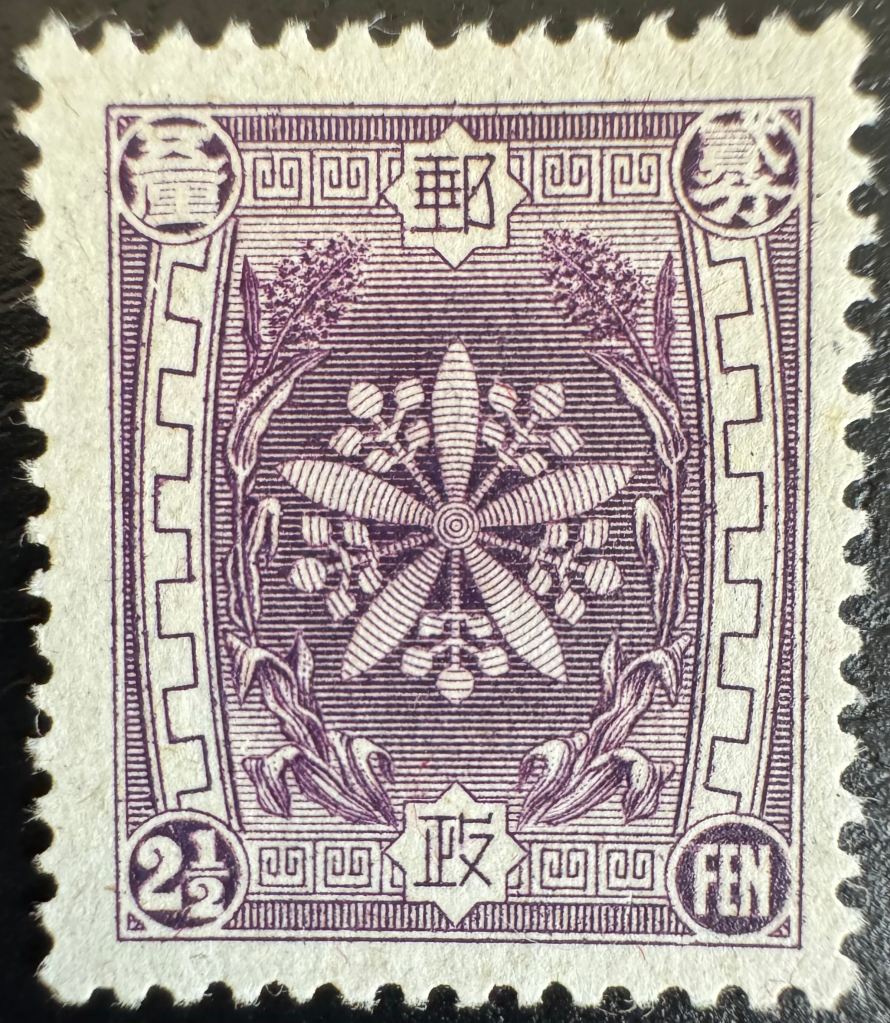
  • This is a beautiful mint Manchukuo stamp from 1937, laden with interesting symbolism relating to the former country of Manchukuo. One of the great joys of stamp collecting is how much a stamp can reveal about the country it represents, and this is a great example. Join me today as I unpack the history of a troubled polity in Northeast Asia, exploring a story of orchids, puppet emperors, and a nation engulfed by history’s deadliest war. 

    Quick Facts

    Issuing Country: Manchukuo (滿洲國)
    Issued: April 1937
    Perforation: 13 x 13½
    Face Value: 2½ Manchukuo fen

    A Brief History of Manchukuo

    You’re not the only one if the name Manchukuo doesn’t ring a bell. The State of Manchuria (later Empire of Great Manchuria) was a short-lived country in the Manchuria/Dongbei region of Northeast China from 1932 to 1945. Manchukuo was a puppet state controlled by the Empire of Japan after it invaded China, beginning the Second Sino-Japanese War, and continuing into World War 2. The Manchus, the people the country is named after, are a Tungusic ethnic group living in the eponymous Manchuria. The Manchus were a nomadic people who rose to power after conquering all of China under the Qing Dynasty, remaining in power from the 17th to the early 20th century. With their ownership of all of modern-day China, most Manchus settled down and assimilated into Chinese culture. Despite Qing efforts to block immigration to Manchuria, Chinese settlers poured in and turned it into a Chinese-majority region. By the 20th century, the region became a hotbed of political conflicts. Japan and Russia struggled to exercise control over the area, while the Qing were too weak to assert their power. Harbin had a large Russian community, especially after the rise of the Soviet Union. After Japan’s invasion, the final Qing emperor, Puyi, was reinstated as the chief executive and later emperor of Manchukuo. However, he was only a figurehead, and the Imperial Japanese Army (IJA) was calling the shots behind the scenes. Millions of Japanese people resettled in the region in a bid to exercise greater control over the area and alleviate overpopulation in the mainland, and the nation stressed racial harmony – its official motto was “Five Races Under One Union”, the ‘five races’ being the Chinese, Japanese, Koreans, Manchus, and Mongols. As the Japanese theatre of WW2 came to a close, Manchukuo was swiftly invaded by the Soviets, by which point it ceased to exist, ending the short-lived imperial ambitions of Puyi and the Japanese.

    A map of Manchukuo. M. Kobayashi & Co. “The topographic map of Manchoukuo.” Map. Tokyo, Japan: Kobayashi & Co, [1933]. Norman B. Leventhal Map & Education Center, https://collections.leventhalmap.org/search/commonwealth:9s161h844

    The Stamp

    This stamp is a fine example of recess printing with its beautiful and intricate design. At the centre is the emblem of Manchukuo, consisting of an orchid flower with sorghum branches between the petals. The orchid is specifically Cymbidium goeringii, the noble orchid, found in East Asian countries such as Japan and China. It was Puyi’s favourite flower and is associated with elegance and gracefulness in East Asian cultures. Despite its origin in Africa, sorghum is a staple cereal in northern China, commonly used to make distilled liquor. The two stalks surrounding the emblem are millet, another common staple in the region. The agricultural motifs symbolize the state’s focus on agriculture and self-sustenance, as Manchukuo was not only a strategically important gateway to China but also a breadbasket for the home islands of Japan. Millions of Japanese settlers were given land to grow food, and, more ominously, guns to defend themselves in case of invasion. The face value of the stamp is 2½ fen, with 1 fen being 1/100th of 1 Manchukuo yuan, the official currency of the state. Collectors of Qing China may be familiar with the term candareen, which is an English version of the Chinese term fen. The fen or candareen was an ancient unit of measurement in China, approximately equivalent to 0.4 grams.

    A History of Manchukuo, Part Two

    Despite its picturesque philatelic items, Manchukuo’s existence represents one of the darkest chapters of Chinese history – the brutal Japanese occupation and invasion of China, in which millions of people were killed and tortured. The city of Harbin in Manchukuo was home to the infamous Unit 731, which committed horrible atrocities on civilians, including live testing of biological weapons. Beneath the facade of racial harmony, Japanese people were given preferential treatment. However, even the Japanese settlers were abandoned by their own country once things went south – thousands committed suicide instead of waiting to see what their revenge-seeking Chinese neighbours and Russian soldiers would do to them. In the end, though, more than a million were eventually repatriated to Japan. 

    Conclusion

    While collecting stamps and admiring their designs may be fun, they can also be a window to the past, and expand our knowledge of history and general happenings in the past. What did a country value in the 1930s? Why do some countries on stamps no longer exist? Despite Manchukuo’s fall decades ago, the lasting scars and trauma of the Japanese occupation still run deep and divide East Asia. Sometimes I don’t like saying I’m a Manchukuo collector for the reason that that word means more than just a faded name from an old map – it means memories of violence, being uprooted, tortured, abused, and an entire country humiliated. But in the end, the more one is educated about history, the less likely they are to repeat it. For a first entry, it turned out very morbid, but it’s important not to view a design or series in isolation, but consider the broader picture and relevance behind it – that’s one thing I love about philately. See you next week, where hopefully we’ll delve into a more lighthearted topic.

  • This week, the first entry of Speaking in Tongues will be the fascinating Crimean Tatar language, spoken by the eponymous group in Crimea. Once the language of the illustrious Crimean Khanate, after centuries of repression and displacement, Crimean Tatar is on the verge of extinction, despite a great literary corpus and ongoing efforts to revive the language. Join us today as we explore this Turkic oddity, spoken in Europe and related to Tatar and Kazakh, yet sometimes sounding more similar to the distantly related Turkish.

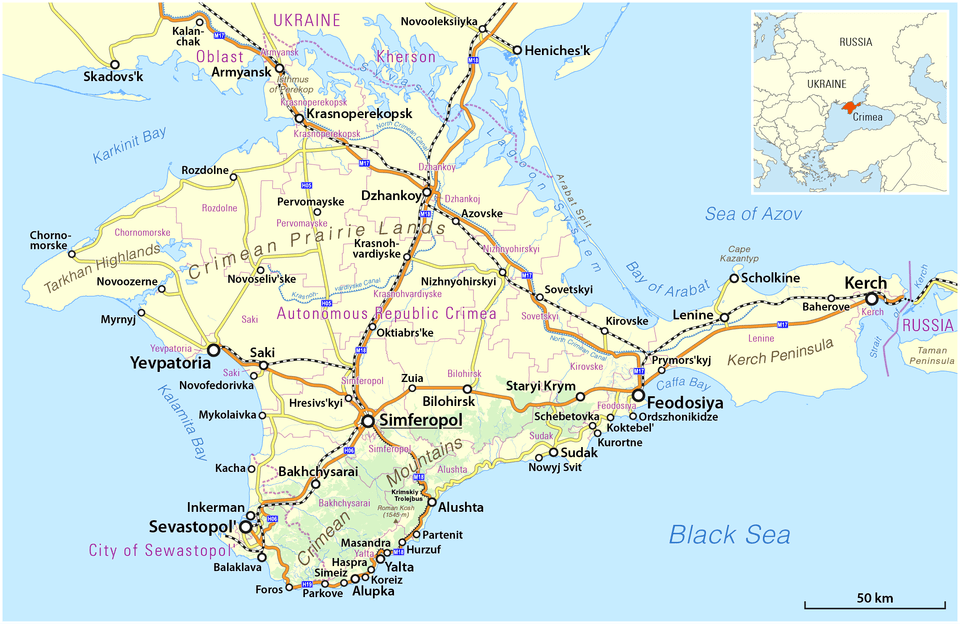
    Crimean Tatar (qırımtatar tili/qırım tili) is a Turkic language of the Kipchak branch, native to the Crimean Peninsula in Russian-occupied Ukraine. Due to forced displacement and migration, significant Crimean Tatar diasporas exist in Uzbekistan, Romania, and Turkey. As a Kipchak language, it is related to languages such as Tatar, Bashkir, Kazakh, and Kyrgyz. However, it has also been significantly influenced by the Oghuz branch of Turkic. Currently, there are around 60,000 speakers of the language, but it is classified as severely endangered by the UNESCO Atlas of the World’s Languages in Danger

    The Crimean Tatars are the indigenous population of the Crimean Peninsula, of diverse ethnic origins. From around the 11th to 14th centuries AD, the nomadic Cumans and Kipchaks expanded into the southern Ukrainian steppe, conquering most of Crimea in the process. However, the ethnogenesis of the Crimean Tatars was much more complex, consisting of a mixture of nomadic steppe groups such as the aforementioned Kipchaks and Cumans, as well as older waves of invasions from groups such as the Alans, Greeks, and Goths, which left their own imprint on the contested region. After centuries, the diverse groups of Crimea formed into a more homogenous identity, consolidated by a shared land, language, and religion. From the late 19th to early 20th century, promoted by Soviet authorities and Crimean Tatar nationalists, the Crimean Tatar identity and a written standard for the language was fully established. Subgroups of the Crimean Tatars include northern (“steppe”) and southern (“mountain”) populations, as well as Crimean Roma. Northern or steppe Crimean Tatars have more genetic affiliation with nomadic groups, while southern Crimean Tatars are considered to be assimilated earlier settlers, such as the Crimean Goths. Similar to the Volga Tatars, the Crimean Tatars are descendants of Cuman and Kipchak nomads; however, their languages, genetic composition, and customs are vastly different. Crimean Tatar culture is closely related to other Turkic groups, sharing a common cultural thread. However, it has many elements that make it a unique reflection of the area’s complex history. The chebureki, a type of meat pie found in Eastern Europe and Turkey, is actually a Crimean Tatar dish called çiberek. Other dishes include yantıq and burma. Crimean Tatar fashion is renowned for its ornately decorated altyn fezzes, a necklace of gold coins called a kokuslyuk, and quşaq belts. Standard Crimean Tatar is based on the Central dialect, however, similar to the north-south split in ethnicity, there was a great amount of dialectal variation. Northern Crimean Tatars spoke a Kipchak-based dialect related to the Nogai language of the Russian steppe, while Southern Crimean Tatars, under the influence of the Ottoman Empire, spoke an Oghuz-based dialect or even an entirely different language. The central dialect was historically a mix of both Oghuz and Kipchak, southern and northern influences. Nonetheless, after the Sürgünlik – the forced deportation of Crimean Tatars to Central Asia – dialectal variations diminished greatly as people from different parts of the peninsula were mixed together. Under Ottoman influence, the Crimean Tatar language was historically written with an Arabic-based script. In 1928 under Soviet guidance the language’s written form transitioned to the Latin alphabet and then in 1938 the Cyrillic alphabet. 

    A map of the Crimean Peninsula

    Once the lingua franca of the entire Crimean Peninsula, the Crimean Tatar language is now severely endangered and the number of speakers is diminishing. An estimated 60,000 people still speak the language, mostly in Crimea and by the diaspora in Central Asia. Crimean Tatar language education exists in Crimea but there are reports of repression by Russian occupation authorities and an emphasis on Russian. Almost all Crimean Tatars are estimated to be bilingual, mostly in Russian. After decades of persecution, forced deportations, and migration, the Crimean Tatar is in a very weak standing. Particularly, the domination of Russian socioeconomically has had drastic consequences on the vitality of the language. The ongoing Russian occupation of the Crimean Peninsula has had unclear consequences on the Crimean Tatar language but reports indicate that it is increasing the Russification and language loss of Crimean Tatar.

    Unfortunately, there are very limited resources for learning Crimean Tatar, and most that exist are in Russian. There are some grammars in English but they are geared to a linguistic perspective and not particularly effective for learning the language.
    Some basic phrases and words in Crimean Tatar include:

    Meraba / selâm aleyküm – Hello | [ˈmɛ.rɑ.bɑ] [sæˈlɑːm ɑˈlej.kym]
    Sabalar hayır – Good morning | [sɑ.bɑˈlɑr hɑˈjɯr]
    Sağ ol – Thank you | [sɑːɣ ol]
    Senim adıñ kim? – What is your name? | [sɛˈnim ɑˈdɯŋ kim]
    Menim adım… – My name is… | [mɛˈnim ɑˈdɯm]

    The Universal Declaration of Human Rights in Crimean Tatar:
    Bütün insanlar serbestlik, menlik ve uquqlarda musaviy olıp dünyağa keleler. Olar aqıl ve vicdan saibidirler ve biri-birilerinen qardaşçasına munasebette bulunmalıdırlar.

    Some spoken examples of the language:
    https://en.wikipedia.org/wiki/File:Qirimtatartili.ogg
    WIKITONGUES: Neceadin speaking Crimean Tatar
    We are Crimean Tatars
    In the last video, many loans from Arabic and Turkish are visible, such as devlet, meaning state or country. The language as a whole has a very melodic tone and is rather pleasing to the ears.

    In conclusion, the Crimean Tatar language is a fascinating window into the history of one of the most troubled and contested regions of the world right now as well as a resplendent culture with many unique traditions and customs. 

    Sources:

    Liana Satenstein, Tasya Kudryk. “The Sad, Rich, Hopeful History of Crimean Tatar Clothing.” Vogue, Vogue, 6 Mar. 2017, www.vogue.com/article/crimean-tatar-traditional-clothing

    Williams, Brian Glyn. “The Ethnogenesis of the Crimean Tatars. An Historical Reinterpretation.” Journal of the Royal Asiatic Society, vol. 11, no. 3, 2001, pp. 329–48. JSTOR, http://www.jstor.org/stable/25188176. Accessed 12 Aug. 2025.

    Kavitskaya, Darya. Crimean Tatar. Lincom Europa, 2010.

    Maximilian Dörrbecker (Chumwa), CC BY-SA 2.0 https://creativecommons.org/licenses/by-sa/2.0, via Wikimedia Commons