This week, the first entry of Speaking in Tongues will be the fascinating Crimean Tatar language, spoken by the eponymous group in Crimea. Once the language of the illustrious Crimean Khanate, after centuries of repression and displacement, Crimean Tatar is on the verge of extinction, despite a great literary corpus and ongoing efforts to revive the language. Join us today as we explore this Turkic oddity, spoken in Europe and related to Tatar and Kazakh, yet sometimes sounding more similar to the distantly related Turkish.
Crimean Tatar (qırımtatar tili/qırım tili) is a Turkic language of the Kipchak branch, native to the Crimean Peninsula in Russian-occupied Ukraine. Due to forced displacement and migration, significant Crimean Tatar diasporas exist in Uzbekistan, Romania, and Turkey. As a Kipchak language, it is related to languages such as Tatar, Bashkir, Kazakh, and Kyrgyz. However, it has also been significantly influenced by the Oghuz branch of Turkic. Currently, there are around 60,000 speakers of the language, but it is classified as severely endangered by the UNESCO Atlas of the World’s Languages in Danger.
The Crimean Tatars are the indigenous population of the Crimean Peninsula, of diverse ethnic origins. From around the 11th to 14th centuries AD, the nomadic Cumans and Kipchaks expanded into the southern Ukrainian steppe, conquering most of Crimea in the process. However, the ethnogenesis of the Crimean Tatars was much more complex, consisting of a mixture of nomadic steppe groups such as the aforementioned Kipchaks and Cumans, as well as older waves of invasions from groups such as the Alans, Greeks, and Goths, which left their own imprint on the contested region. After centuries, the diverse groups of Crimea formed into a more homogenous identity, consolidated by a shared land, language, and religion. From the late 19th to early 20th century, promoted by Soviet authorities and Crimean Tatar nationalists, the Crimean Tatar identity and a written standard for the language was fully established. Subgroups of the Crimean Tatars include northern (“steppe”) and southern (“mountain”) populations, as well as Crimean Roma. Northern or steppe Crimean Tatars have more genetic affiliation with nomadic groups, while southern Crimean Tatars are considered to be assimilated earlier settlers, such as the Crimean Goths. Similar to the Volga Tatars, the Crimean Tatars are descendants of Cuman and Kipchak nomads; however, their languages, genetic composition, and customs are vastly different. Crimean Tatar culture is closely related to other Turkic groups, sharing a common cultural thread. However, it has many elements that make it a unique reflection of the area’s complex history. The chebureki, a type of meat pie found in Eastern Europe and Turkey, is actually a Crimean Tatar dish called çiberek. Other dishes include yantıq and burma. Crimean Tatar fashion is renowned for its ornately decorated altyn fezzes, a necklace of gold coins called a kokuslyuk, and quşaq belts. Standard Crimean Tatar is based on the Central dialect, however, similar to the north-south split in ethnicity, there was a great amount of dialectal variation. Northern Crimean Tatars spoke a Kipchak-based dialect related to the Nogai language of the Russian steppe, while Southern Crimean Tatars, under the influence of the Ottoman Empire, spoke an Oghuz-based dialect or even an entirely different language. The central dialect was historically a mix of both Oghuz and Kipchak, southern and northern influences. Nonetheless, after the Sürgünlik – the forced deportation of Crimean Tatars to Central Asia – dialectal variations diminished greatly as people from different parts of the peninsula were mixed together. Under Ottoman influence, the Crimean Tatar language was historically written with an Arabic-based script. In 1928 under Soviet guidance the language’s written form transitioned to the Latin alphabet and then in 1938 the Cyrillic alphabet.
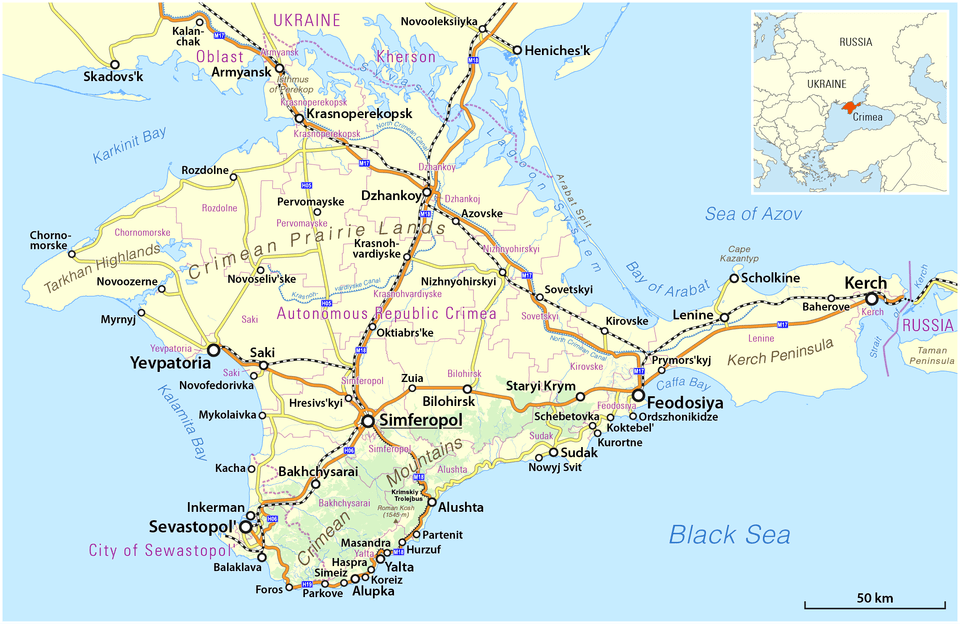
Once the lingua franca of the entire Crimean Peninsula, the Crimean Tatar language is now severely endangered and the number of speakers is diminishing. An estimated 60,000 people still speak the language, mostly in Crimea and by the diaspora in Central Asia. Crimean Tatar language education exists in Crimea but there are reports of repression by Russian occupation authorities and an emphasis on Russian. Almost all Crimean Tatars are estimated to be bilingual, mostly in Russian. After decades of persecution, forced deportations, and migration, the Crimean Tatar is in a very weak standing. Particularly, the domination of Russian socioeconomically has had drastic consequences on the vitality of the language. The ongoing Russian occupation of the Crimean Peninsula has had unclear consequences on the Crimean Tatar language but reports indicate that it is increasing the Russification and language loss of Crimean Tatar.
Unfortunately, there are very limited resources for learning Crimean Tatar, and most that exist are in Russian. There are some grammars in English but they are geared to a linguistic perspective and not particularly effective for learning the language.
Some basic phrases and words in Crimean Tatar include:
Meraba / selâm aleyküm – Hello | [ˈmɛ.rɑ.bɑ] [sæˈlɑːm ɑˈlej.kym]
Sabalar hayır – Good morning | [sɑ.bɑˈlɑr hɑˈjɯr]
Sağ ol – Thank you | [sɑːɣ ol]
Senim adıñ kim? – What is your name? | [sɛˈnim ɑˈdɯŋ kim]
Menim adım… – My name is… | [mɛˈnim ɑˈdɯm]
The Universal Declaration of Human Rights in Crimean Tatar:
Bütün insanlar serbestlik, menlik ve uquqlarda musaviy olıp dünyağa keleler. Olar aqıl ve vicdan saibidirler ve biri-birilerinen qardaşçasına munasebette bulunmalıdırlar.
Some spoken examples of the language:
https://en.wikipedia.org/wiki/File:Qirimtatartili.ogg
WIKITONGUES: Neceadin speaking Crimean Tatar
We are Crimean Tatars
In the last video, many loans from Arabic and Turkish are visible, such as devlet, meaning state or country. The language as a whole has a very melodic tone and is rather pleasing to the ears.
In conclusion, the Crimean Tatar language is a fascinating window into the history of one of the most troubled and contested regions of the world right now as well as a resplendent culture with many unique traditions and customs.
Sources:
Liana Satenstein, Tasya Kudryk. “The Sad, Rich, Hopeful History of Crimean Tatar Clothing.” Vogue, Vogue, 6 Mar. 2017, www.vogue.com/article/crimean-tatar-traditional-clothing.
Williams, Brian Glyn. “The Ethnogenesis of the Crimean Tatars. An Historical Reinterpretation.” Journal of the Royal Asiatic Society, vol. 11, no. 3, 2001, pp. 329–48. JSTOR, http://www.jstor.org/stable/25188176. Accessed 12 Aug. 2025.
Kavitskaya, Darya. Crimean Tatar. Lincom Europa, 2010.
Maximilian Dörrbecker (Chumwa), CC BY-SA 2.0 https://creativecommons.org/licenses/by-sa/2.0, via Wikimedia Commons
 Speaking in Tongues
Leave a comment