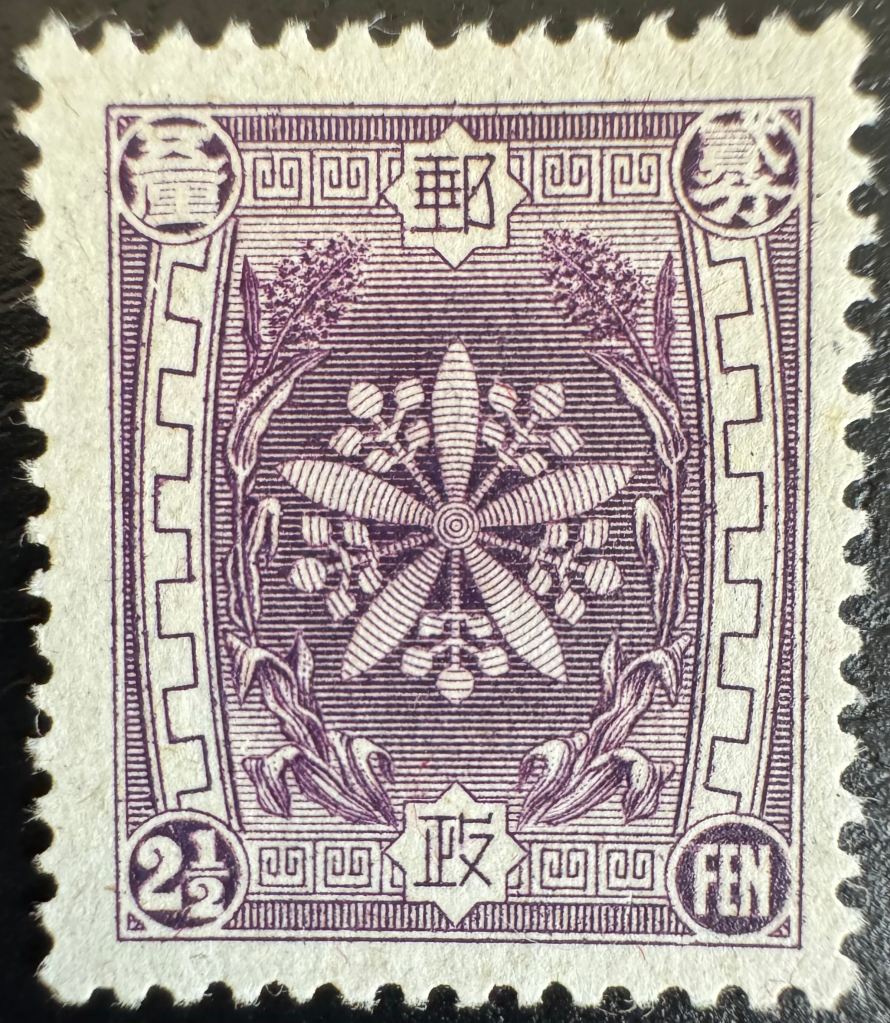
This is a beautiful mint Manchukuo stamp from 1937, laden with interesting symbolism relating to the former country of Manchukuo. One of the great joys of stamp collecting is how much a stamp can reveal about the country it represents, and this is a great example. Join me today as I unpack the history of a troubled polity in Northeast Asia, exploring a story of orchids, puppet emperors, and a nation engulfed by history’s deadliest war.
Quick Facts
Issuing Country: Manchukuo (滿洲國)
Issued: April 1937
Perforation: 13 x 13½
Face Value: 2½ Manchukuo fen
A Brief History of Manchukuo
You’re not the only one if the name Manchukuo doesn’t ring a bell. The State of Manchuria (later Empire of Great Manchuria) was a short-lived country in the Manchuria/Dongbei region of Northeast China from 1932 to 1945. Manchukuo was a puppet state controlled by the Empire of Japan after it invaded China, beginning the Second Sino-Japanese War, and continuing into World War 2. The Manchus, the people the country is named after, are a Tungusic ethnic group living in the eponymous Manchuria. The Manchus were a nomadic people who rose to power after conquering all of China under the Qing Dynasty, remaining in power from the 17th to the early 20th century. With their ownership of all of modern-day China, most Manchus settled down and assimilated into Chinese culture. Despite Qing efforts to block immigration to Manchuria, Chinese settlers poured in and turned it into a Chinese-majority region. By the 20th century, the region became a hotbed of political conflicts. Japan and Russia struggled to exercise control over the area, while the Qing were too weak to assert their power. Harbin had a large Russian community, especially after the rise of the Soviet Union. After Japan’s invasion, the final Qing emperor, Puyi, was reinstated as the chief executive and later emperor of Manchukuo. However, he was only a figurehead, and the Imperial Japanese Army (IJA) was calling the shots behind the scenes. Millions of Japanese people resettled in the region in a bid to exercise greater control over the area and alleviate overpopulation in the mainland, and the nation stressed racial harmony – its official motto was “Five Races Under One Union”, the ‘five races’ being the Chinese, Japanese, Koreans, Manchus, and Mongols. As the Japanese theatre of WW2 came to a close, Manchukuo was swiftly invaded by the Soviets, by which point it ceased to exist, ending the short-lived imperial ambitions of Puyi and the Japanese.

The Stamp
This stamp is a fine example of recess printing with its beautiful and intricate design. At the centre is the emblem of Manchukuo, consisting of an orchid flower with sorghum branches between the petals. The orchid is specifically Cymbidium goeringii, the noble orchid, found in East Asian countries such as Japan and China. It was Puyi’s favourite flower and is associated with elegance and gracefulness in East Asian cultures. Despite its origin in Africa, sorghum is a staple cereal in northern China, commonly used to make distilled liquor. The two stalks surrounding the emblem are millet, another common staple in the region. The agricultural motifs symbolize the state’s focus on agriculture and self-sustenance, as Manchukuo was not only a strategically important gateway to China but also a breadbasket for the home islands of Japan. Millions of Japanese settlers were given land to grow food, and, more ominously, guns to defend themselves in case of invasion. The face value of the stamp is 2½ fen, with 1 fen being 1/100th of 1 Manchukuo yuan, the official currency of the state. Collectors of Qing China may be familiar with the term candareen, which is an English version of the Chinese term fen. The fen or candareen was an ancient unit of measurement in China, approximately equivalent to 0.4 grams.
A History of Manchukuo, Part Two
Despite its picturesque philatelic items, Manchukuo’s existence represents one of the darkest chapters of Chinese history – the brutal Japanese occupation and invasion of China, in which millions of people were killed and tortured. The city of Harbin in Manchukuo was home to the infamous Unit 731, which committed horrible atrocities on civilians, including live testing of biological weapons. Beneath the facade of racial harmony, Japanese people were given preferential treatment. However, even the Japanese settlers were abandoned by their own country once things went south – thousands committed suicide instead of waiting to see what their revenge-seeking Chinese neighbours and Russian soldiers would do to them. In the end, though, more than a million were eventually repatriated to Japan.
Conclusion
While collecting stamps and admiring their designs may be fun, they can also be a window to the past, and expand our knowledge of history and general happenings in the past. What did a country value in the 1930s? Why do some countries on stamps no longer exist? Despite Manchukuo’s fall decades ago, the lasting scars and trauma of the Japanese occupation still run deep and divide East Asia. Sometimes I don’t like saying I’m a Manchukuo collector for the reason that that word means more than just a faded name from an old map – it means memories of violence, being uprooted, tortured, abused, and an entire country humiliated. But in the end, the more one is educated about history, the less likely they are to repeat it. For a first entry, it turned out very morbid, but it’s important not to view a design or series in isolation, but consider the broader picture and relevance behind it – that’s one thing I love about philately. See you next week, where hopefully we’ll delve into a more lighthearted topic.
 Speaking in Tongues
Leave a comment