Today, we will be looking at a stamp I picked up a while ago with a turbulent history of post-Soviet conflicts, spheres of influence, forgeries, and international recognition. Despite looking nondescript, this stamp is a great insight into one of the world’s most contested regions.
Quick Facts
Issuing Country: Abkhazia (Аԥсны)
Catalogue: Michel AB 402
Issued: April 2000
Perforation: 11½
Face value: 0.90 Russian ruble
The Stamp
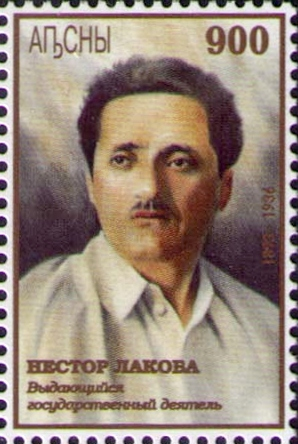
For this stamp, it would be easier to introduce it first, then explain its significance. This is a commemorative issue from Abkhazia, a place you won’t find on a list of countries. This is because Abkhazia is a region of northwestern Georgia recognized only by 5 other countries, which might become 4 in the future with the new regime change in Syria. Along with its status as a non-country, Abkhazian stamps are not recognized by the Universal Postal Union, and are practically only valid for post within the small area itself. The design consists of the flag of the Socialist Soviet Republic of Abkhazia (Социалистическая Советская Республика Абхазия, CCPA) with Abkhazia’s name in Abkhaz, Аԥсны (Aṕsny), to the side. Despite being relatively basic, this stamp is loaded with information about the region’s past and current status, which will be discussed further in the next section.
History
The Abkhaz are a people native to the Caucasus region but of unclear origins. They are likely descended from the ancient Abasgoi tribe, who inhabited and gave their name to modern-day Abkhazia. Throughout most of Abkhaz history, Georgian polities ruled over the region, most famously including the Kingdom of Abkhazia, which at one point controlled almost all of modern-day Georgia, and its successor, the Kingdom of Georgia, under which Georgia entered a “golden age”. In the 16th century, the Ottoman Empire turned the Principality of Abkhazia into its sphere of influence, gradually converting many Abkhazians to Islam. The famous Turkish traveller (of Abkhaz descent himself) Evliya Çelebi was the first one to document the Abkhaz as speaking a language different from Georgian, in the 17th century.
In 1864, Abkhazia was formally annexed by the Russian Empire, beginning centuries of Russian hegemony. Many Abkhazians were deported, leading to the repopulation of the region with mostly Georgians, Russians, and Armenians. The Socialist Soviet Republic of Abkhazia was established after the Red Army overran Georgia in 1921 during the Russian Civil War, led by Nestor Lakoba. Lakoba, popular with both the Abkhaz and Stalin, managed to dodge the worst of Soviet collectivization in the 1930s, preventing an atrocity such as the Holodomor from occurring in his homeland. Lakoba was poisoned in 1936 by an ambitious confidante of Stalin named Lavrentiy Beria, who was an ethnic Georgian from Abkhazia, and thereafter condemned as an enemy of the people and had most of his family killed as well. Beria then consolidated his control over all of Abkhazia, suppressing Abkhaz culture, purging his opponents, and resettling the region with Georgians and Russians.
In the buildup to the dissolution of the Soviet Union, ethnic conflicts intensified in Abkhazia, with Georgians and Abkhaz frequently clashing, such as in the Sukhumi riot that left 18 dead and hundreds wounded. Georgia declared independence on the 9th of April 1991 under Zviad Gamsakhurdia, who was replaced in 1992 by Eduard Shevardnadze. After a perceived move to undermine Abkhaz autonomy, fighting broke out between Abkhaz and Russian militias and Georgian forces. In late 1993, Sukhumi fell, followed by a massacre against the Georgian residents of the city, leading thousands to leave Abkhazia, fearing for their lives. To complicate matters further, supporters of the deposed Gamsakhurdia rose up in his native Mingrelia, further turning Georgian attention away from Abkhazia and leading to Abkhaz militias overrunning almost all of Abkhazia. A widespread ethnic cleansing of Georgians occurred throughout the 90s, with most of the Georgian population being killed or forcibly displaced. In 1999, Abkhazia formally declared independence and has been practically entirely dependent on Russia ever since. The conflict is still in a deadlock, although tensions have simmered down, and there is cross-border travel and commerce.

Abkhazian Philately
Since Abkhazia is not recognized by most countries, it is also not part of the Universal Postal Union (UPU), which means that stamps from Abkhazia are not valid for international mail. Abkhazia has had a prolific output of stamps since its declaration of independence and there is even a catalogue of Abkhazian stamps, as well as some collectors in Sukhumi who have kept painstaking track of every emission. However, to Western philatelists, Abkhazia is probably more famous as being the purported origin of many goofy or strange stamps, which were in reality forgeries. The most famous example is the infamous “Abkhazian” Bill Clinton issues, which made fun of the Clinton-Lewinsky affair through tongue-in-cheek references. Abkhazia in general was a prime target for stamp counterfeiters due to its relative obscurity, leading to more illegal stamps under the name of Abkhazia than legitimate stamps issued by the country.

Conclusion
In the end, this small stamp tells a story far larger than its size suggests, reflecting the fraught history of Abkhazia—a land caught between empires, scarred by ethnic conflict, and suspended in a limbo of partial recognition—and a stark reminder that even the most modest artifacts can carry the weight of history, politics, and the struggles of a people seeking their place in the world.
 Speaking in Tongues
Leave a comment