I am aware this has been pushed out very late—It’s been a busy few couple of weeks but there’ll be more content shortly! Today we will be covering the Miskito language of coastal Nicaragua and Honduras. Miskito has an elaborate history of autonomy, linguistic contact, and suppression, surviving into the 21st century but in a tenuous position with the growing role of Spanish. The history of the Miskito people also reflects a unique microcosm of many processes in Latin American history, such as the contact between Africans, Indigenous peoples, as well as European settlers.
Background
Miskito is the most spoken language of the small Misumalpan family, located on the eponymous Mosquito Coast in Honduras and Nicaragua. The Mosquito Coast is a lush, forested, and relatively inaccessible region with a very low population density, which is partly responsible for the continued use of Miskito—only around 10% of Nicaragua’s population lives along the Atlantic Coast. Nicaragua’s Atlantic and Pacific coasts developed vastly differently, with the Atlantic coastline being dominated by the English for centuries and then economically exploited by Americans, leading to the development of Rama Cay Creole and Moskitian Creole, two English-based creole languages in the region. Furthermore, as a destination for marooned slaves, the Mosquito Coast also has a large population of African descent.
History
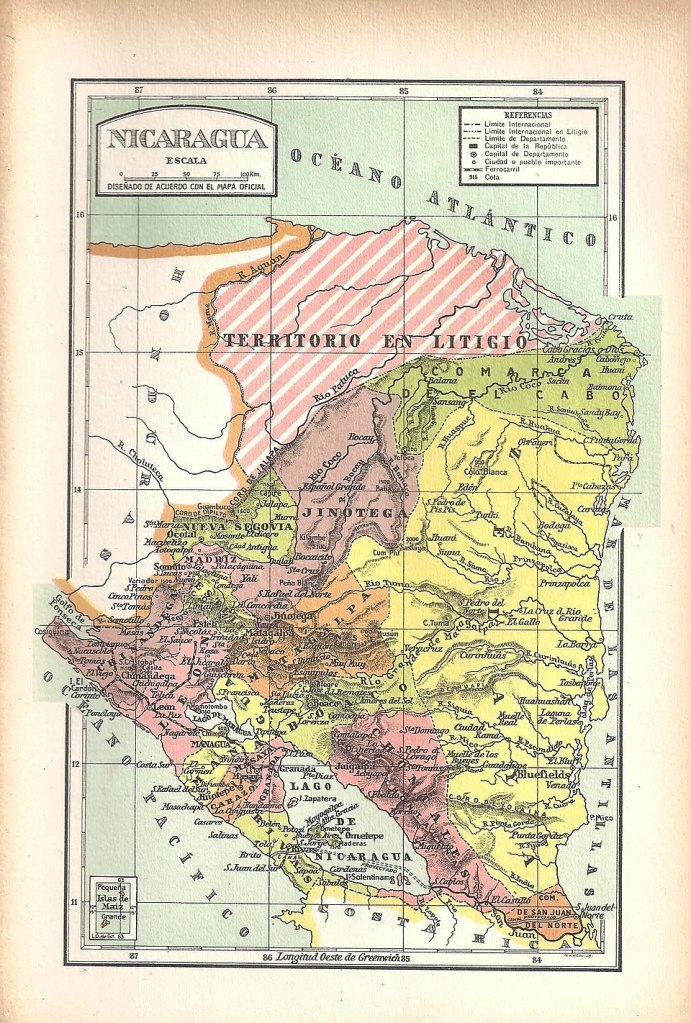
During the seventeenth century, the English tried to block Spanish expansion by establishing colonies along the Caribbean coast of Central America, although only Belize and the Nicaraguan Coast were semi-successful ventures. While the Spanish claimed all of Central America, they had no control over the Mosquito Coast, which was instead ruled by a hereditary monarchy under the House of Miskito, propped up by and tied to British interests in the region. Throughout the late 18th to early 19th centuries, a flourishing culture of marooned and then freed slaves propped up around coastal centres such as Bluefields, creating an ‘elite’ class that had great political and economic control over the region.
The First Treaty of Managua in 1860 turned the Mosquito Coast into a self-governing region of Nicaragua, opening the region up to exploitation by companies and increasing loss of autonomy from the Nicaraguan government. Given the critical location of Nicaragua, there were serious attempts to build a canal before the Panama Canal was built. All the proposed canal routes would have to start at either Bluefields or San Juan, both on the Mosquito Coast. Latex and logging were early lucrative ventures, but the export that outshone them all was bananas. Beginning in the 1880s, they grew to dominate the local economy, which was exploitation-oriented.
In 1894, President Zelaya undertook the Reincorporation of the Mosquitia into Nicaragua; however, later, seeing him as a threat to American business interests, the U.S. Marines invaded the country and overthrew him. Throughout the 1920s, revolutionary Augusto Sandino’s rebellion against the American occupation targeted American businesses and caused substantial damage, leading to many American businesses leaving the country only to return under the Somoza regime, ramping up their exploitative practices and causing increasing friction between the Miskitos and Hispano-Nicaraguans. The Sandinistas who overthrew Somoza failed at least initially to empower Miskitos, but the 1987 Autonomy Statute created the South and North Caribbean Autonomous Regions—two autonomous entities to represent creoles, Miskitos, and related indigenous groups.

Culture
The Miskito originated as a small group around the Coco River between Nicaragua and Honduras. They engaged in small-scale agriculture supplemented by hunting and gathering. Notably, they hunted sea turtles, which also played an important role in their culture. They had a complex system of kinship where leaders or chiefs indebted people by giving them gifts, winning their loyalty. With the growth of English contact, these sparse groups began to mix with runaway slaves and marauding Europeans, obtaining technology and trade goods, growing in power, and raiding and expanding along the Atlantic coast. The ethnogenesis of the Miskito lies in their expansion and European contact, as both their acquisition of European trappings and mixture with former African slaves was what differentiated them from their Misumalpan-speaking neighbors. The Miskito had a hereditary monarchy, but it was in effect no more than a chiefdom. In the 20th century, many Chinese people settled around the coast and mixed with the Miskito population. The Moravian Church, starting in the mid-19th century, won many converts within the Miskito for their social work, but Miskito religion is still heavily influenced by their pre-Christian shamanistic and traditional practices.
Language
The Miskito language, though influenced by English, Spanish, and traces of African languages, has retained a strong internal structure with relatively minor dialectal variation across its 5 main dialects. Miskito word formation is largely from a small set of monosyllabic roots, and the language frequently uses reduplication to form nouns from verbs. Cultural concepts also shape expression, for example, the Miskito locate life and emotions in the heart (kupya), while the Sumu associate them with the liver. Grammar is marked by limited case inflection, with possession indicated syntactically rather than morphologically. Interestingly, similarly to colloquial English, superlatives are often formed with the word saura (“bad/awful”), comparable to “wicked” or “nasty”, both of which mean something is agreeable in the common parlance. Sentence structure typically places the verb at the end, and infinitive endings vary by dialect, with Miskito using -aya. Miskito is part of the Colombian–Central American linguistic area, along with the Chibchan languages, with which Miskito has indeed had extensive contact. Interestingly, Chibchan languages are agglutinative and have vastly different phoneme inventories.
Modern Day
The Miskito language remains strong in Nicaragua’s North Caribbean Coast Autonomous Region, where many communities still use it as their primary language, and it holds official recognition in local education, signage, and media. To counter the dominance of Spanish, which pressures younger generations toward bilingualism and language shift, a bilingual-bicultural education program was launched in 1984, offering Miskito-language instruction alongside Spanish in communities representing multiple dialects. While Miskito continues to fare better than related indigenous languages like Sumu and Rama, which are more endangered, its long-term survival depends on ongoing support from governmental institutions as well as the community itself.

Examples
Universal Declaration of Human Rights in Miskito (Article 1):
Upla sut ba kulkanka lakara, airaitka nanira bara pri, sin, aikuki, baku takisa. Bamna sins laka bri baku, lukanka bain pri baku aimuihni lakara, pana pana tabaikan kaiasa.
All human beings are born free and equal in dignity and rights. They are endowed with reason and conscience and should act towards one another in a spirit of brotherhood.
Sources
Conzemius, Eduard. “Notes on the Miskito and sumu languages of eastern Nicaragua and Honduras.” International Journal of American Linguistics, vol. 5, no. 1, Mar. 1929, pp. 57–115, https://doi.org/10.1086/463773.
Noveck, Daniel. “Class, culture, and the miskito indians: A historical perspective.” Dialectical Anthropology, vol. 13, no. 1, 1988, https://doi.org/10.1007/bf00244348.
Olien, Michael D. “The Miskito Kings and the line of Succession.” Journal of Anthropological Research, vol. 39, no. 2, July 1983, pp. 198–241, https://doi.org/10.1086/jar.39.2.3629967.
Sollis, Peter. “The Atlantic coast of Nicaragua: Development and autonomy.” Journal of Latin American Studies, vol. 21, no. 3, Oct. 1989, pp. 481–520, https://doi.org/10.1017/s0022216x00018526.
Attributions (in order):
Public domain
Kaidor, CC BY-SA 4.0 https://creativecommons.org/licenses/by-sa/4.0, via Wikimedia Commons
Susan Ruggles, CC BY 2.0 https://creativecommons.org/licenses/by/2.0, via Wikimedia Commons
 Speaking in Tongues
Leave a comment